

How much does labeling cost? At first glance, the math seems simple: the price of the printer, the price of the ink cartridge—that’s it. However, when comparing direct printing and labels, this approach falls short. After all, the cost of a device or a label alone isn’t the only deciding factor.
Why the price of the device alone doesn't tell the whole story
A mobile direct-printing device initially involves higher upfront costs than a simple label dispenser or, for example, a manual stamp. However, this investment is not made just for a single print job. A marking device can be used over a long period of time for a wide variety of print formats: for example, text, batch numbers, best-before dates, barcodes, QR codes, sequential numbering, or logos. The cost of the device should therefore not be fully attributed to a single job. Simply put: Cost per marking = purchase price ÷ number of markings over the useful life
The more intensively a device is used, the lower the equipment cost per marking becomes. A device used for, say, 20 prints per month must therefore be evaluated completely differently than the same device when used for several hundred or thousand markings.
The biggest variable cost factor: ink
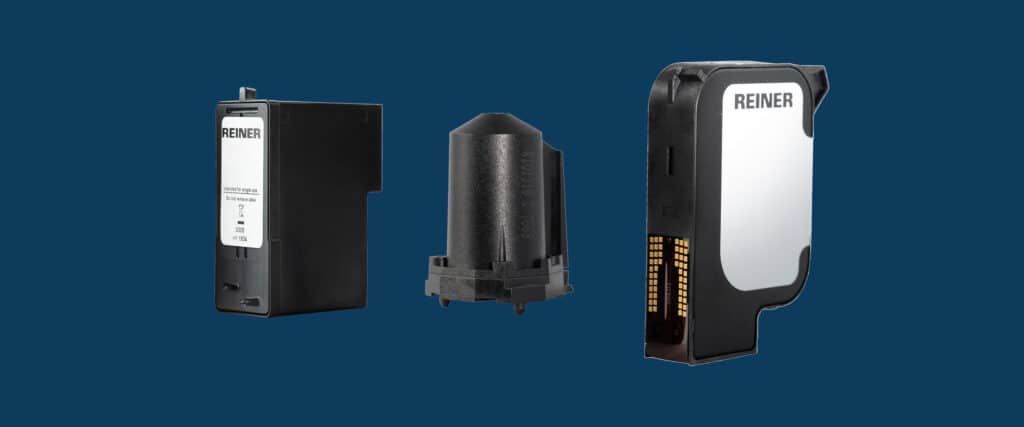
In direct printing, the ink accounts for the bulk of the ongoing material consumption. Different types of ink are available depending on the surface to be printed. Water-based inks are suitable for absorbent materials such as paper, cardboard, or wood, among others. For non-absorbent materials such as plastic or metal, quick-drying inks are available. However, the actual cost of a single print cannot be reliably determined based solely on the price of the ink cartridge. The key question is: How much ink is consumed per print?
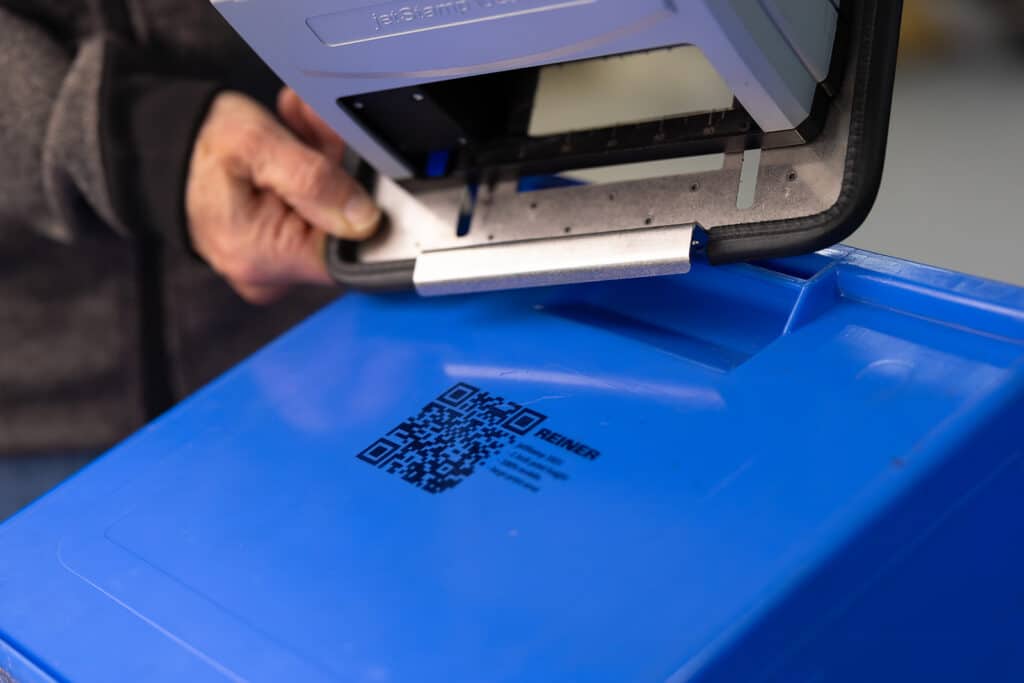
A large QR code uses more ink than a small lot number
Not every print job requires the same amount of ink. Ink consumption is influenced by, among other things:
- the size of the print image,
- the ink coverage
- Font size and font,
- Number and size of barcodes or 2D codes,
- Logos and graphics,
- Print intensity,
- as well as the actual printed area.
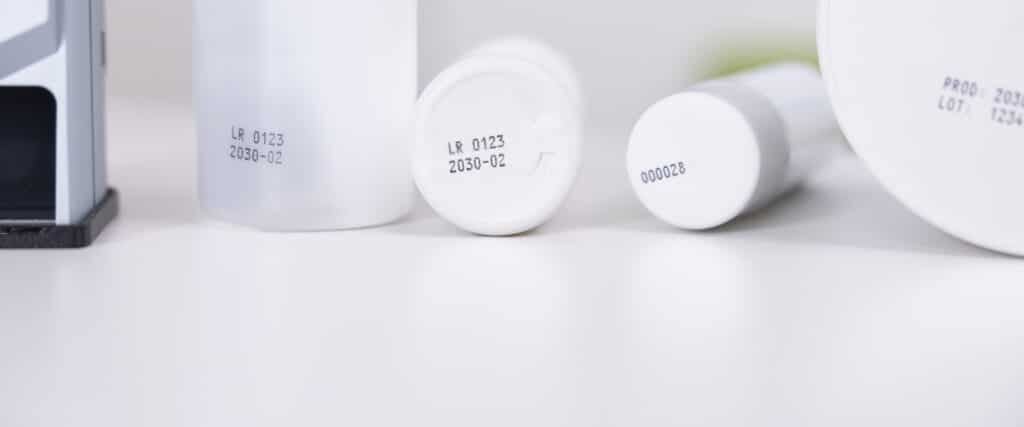
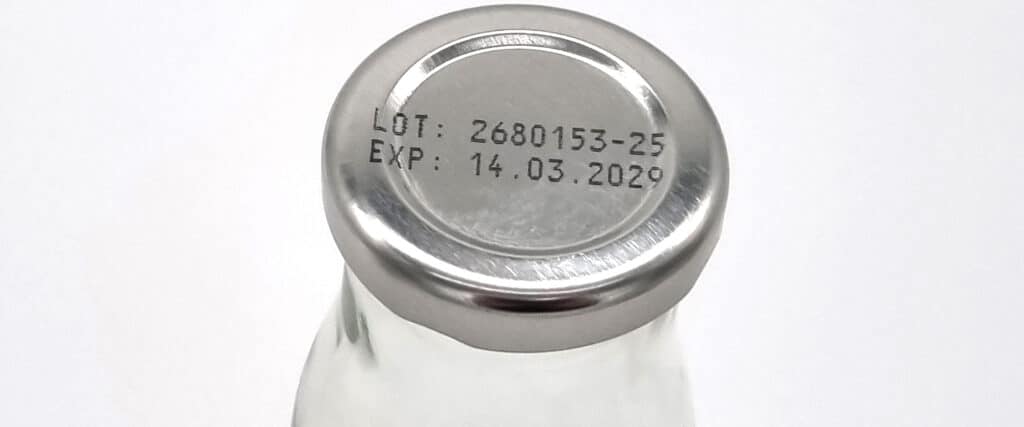
A small print image such as
LOT 4711 – October 6, 2026
requires significantly less ink than a print area that is nearly completely filled with a logo, a large DataMatrix code, and several lines of text. This is precisely why general statements such as „one cartridge is enough for X prints“ are only meaningful if the underlying print image is also known.
Here's how to calculate the ink cost per print
If the cartridge price and actual print yield for a specific print job are known, the calculation is simple: Ink cost per print = price of the cartridge ÷ number of possible prints
A very simplified example:
Assume an ink cartridge costs €150 and can produce prints of a specific print image..
This results in: 150 € ÷ 30,000 = 0.005 € so 0.5 cents in ink costs per marking.
If a different print image with significantly higher ink coverage could only be printed 10,000 times due to a significantly higher ink fill level, the ink costs would already amount to: 150 € ÷ 10,000 = 0.015 € so 1.5 cents per print.
This example shows that it is not the price of the cartridge alone that determines cost-effectiveness—but rather, above all, the actual print yield for the respective print image.
What role does the material play?
The material to be marked is also a factor in the cost analysis. This is because paper, cardboard, and wood place different demands on the ink than plastic, metal, or glass. For absorbent surfaces, for example, a water-based ink can be used. For many non-absorbent materials, however, special quick-drying inks are required.
Direct Printing or Labels: What Should Really Be Compared?
When comparing labels, people often make a logical error. They end up comparing:
The Price of a label with the price of an ink cartridge.
That's not a complete comparison. The truly relevant factor is:
Cost per completed marking.
Labeling can result in the following costs, for example:
- Label Material: The label itself incurs material costs for each individual marking.
- Ribbon or printing medium Depending on the printing method, additional ribbons, ink, or thermal media may be required.
- Printer and Labeling Machine Labeling also involves purchase and maintenance costs.
- Warehousing Depending on the situation, it may be necessary to keep different label formats or preprinted versions in stock.
- Procurement Labels must be ordered, delivered, stored, and made available internally.
- Handling The label must be printed, peeled off or dispensed, and then applied correctly.
- Scrap and Incorrect Labeling Incorrectly printed, damaged, or misaligned labels can result in additional costs.
Direct printing can eliminate some of these steps entirely because the information is printed directly onto the product or packaging.
The Often Underestimated Cost Factor: labor time
Especially with manual labeling processes, labor time can be more significant from a cost perspective than the actual consumables. Suppose that printing and applying a label takes a total of five seconds longer than direct labeling. For ten labels, this makes practically no difference.
However, with 100,000 labels, those five additional seconds add up to: 500,000 seconds, or about 139 working hours.
Assuming internal labor costs of 40 euros per hour, that would already amount to approximately: €5,560 in additional labor costs. This means that a few seconds per operation can be far more significant in terms of cost-effectiveness than fractions of a cent spent on supplies. That is precisely why cost-effectiveness calculations should not stop at the price of materials.
A simple example: Direct printing vs. labels
To illustrate this, let's consider a hypothetical use case involving 50,000 markings per year.
Option 1: Label
The following are assumed:
- Label, including printing costs: €0.05
- Additional handling costs: 0.04 €
- Total: 0.09 € per label
At 50,000 markings per year, the total annual cost is 4,500 euros per year.
Option 2: Direct Printing
The following are assumed:
- Ink: 0.01 € per marking
- Pro-rated equipment costs: 0.02 €
- Handling fee: 0.02 €
- Total: €0.05 per marking
At 50,000 markings per year, the total annual cost is €2,500
Difference: 2,000 euros per year.
These figures are intentionally provided only as an illustrative example. They are not intended to represent the standard costs for a REINER printer or label. Rather, they demonstrate how a meaningful analysis should be structured.
When is direct printing particularly cost-effective?
Direct printing can be particularly useful when:
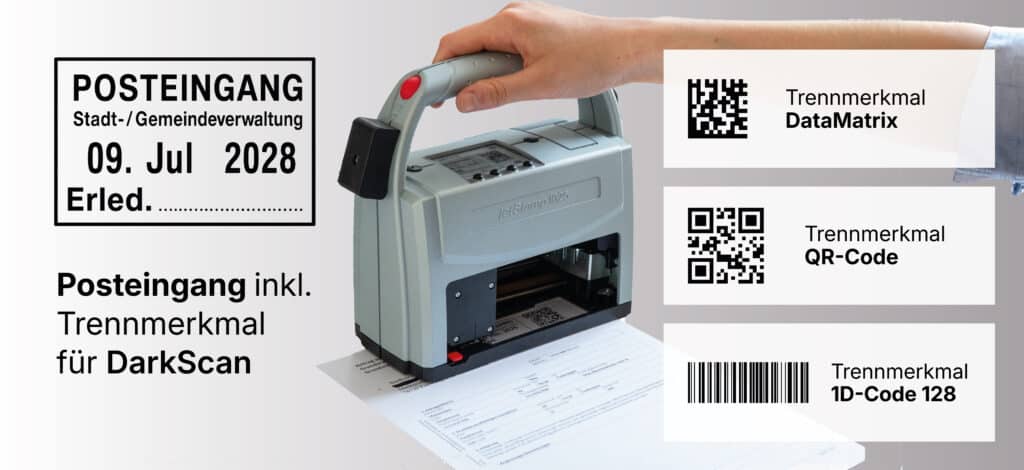
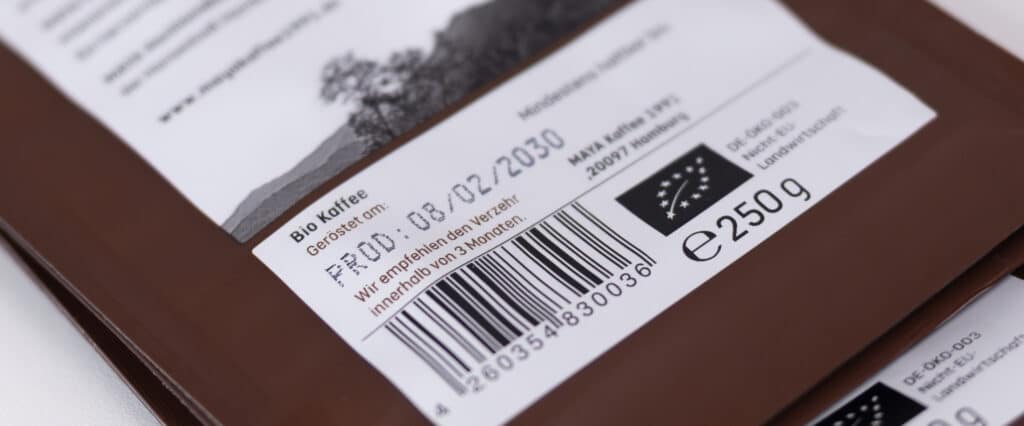
- A wide variety of information is printed: Batch numbers, serial numbers, dates, and barcodes change regularly. A digital direct-printing system can generate variable content on the spot without the need to keep a stock of different pre-printed labels.
- Frequently switching between small and medium batch sizes: Direct printing can be particularly flexible when products change frequently. Instead of keeping separate labels on hand for different variants, various print designs can be stored digitally and selected as needed.
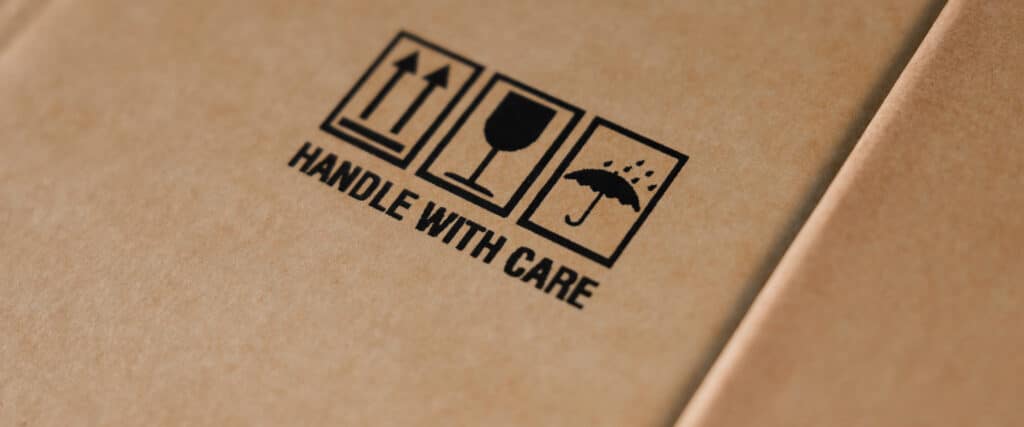
- A label is created late in the process: Some data isn't finalized until just before shipping or production—for example, batch number, serial number, test values, or customer-specific information. In these cases, direct printing can be particularly useful because the customization can be applied directly to the product.
- Labels create extra work: If labels are currently printed, peeled off, positioned, and affixed by hand, it is worth including this labor time in the cost-benefit analysis.
- A wide variety of materials can be labeled: Depending on the device and ink, mobile direct-printing systems can be used on a variety of surfaces. This can be particularly useful in situations where products, packaging, or load carriers are not always identical.
When is a label more cost-effective?
Direct printing is not necessarily the most cost-effective solution for every application.
- Very small quantities: For those who only need a few labels per year, purchasing their own direct-printing system may not be cost-effective.
- Extremely affordable standard labels: When dealing with very large quantities, identical labels, and fully automated labeling processes, the cost per label can be very low. In such a process, switching may offer only a minor economic benefit.
- The surface is not suitable for direct printing: The key factor is always that the marking adheres sufficiently to the material in question and remains legible. If this cannot be reliably achieved due to the surface, coating, or environmental conditions, a suitable label may be the better solution.
- The label serves additional functions: For example, a label can serve simultaneously as a seal, a source of information, a high-quality design element, or multicolored product identification. In such cases, black direct printing does not automatically replace all of its functions.
So the key question isn't, „How much does the printer cost?“
If you want to compare identification methods from a cost perspective, you shouldn't focus solely on the price of the device. A better question to ask is: What is the total cost of a completed marking?
These costs include consumables, equipment investment, and labor, as well as warehousing, procurement, scrap, and process overhead. Direct printing can therefore be economically attractive, especially when dealing with frequently changing data, varying print designs, and manual labeling processes. For low-volume runs or highly optimized automated labeling processes, however, labels may still be the more cost-effective solution.
Conclusion: Compare cost per impression rather than the price of the device
The purchase price alone says little about which marking method is more cost-effective in the long run. To make a meaningful assessment, companies should therefore answer three questions:
- How much do the supplies cost per actual label?
- How much labor and processing time is required per label?
- How many items are the acquisition costs allocated to?
Only then can one determine whether direct printing or labeling is more cost-effective for the specific application.





 German
 English
 French
 Spanish